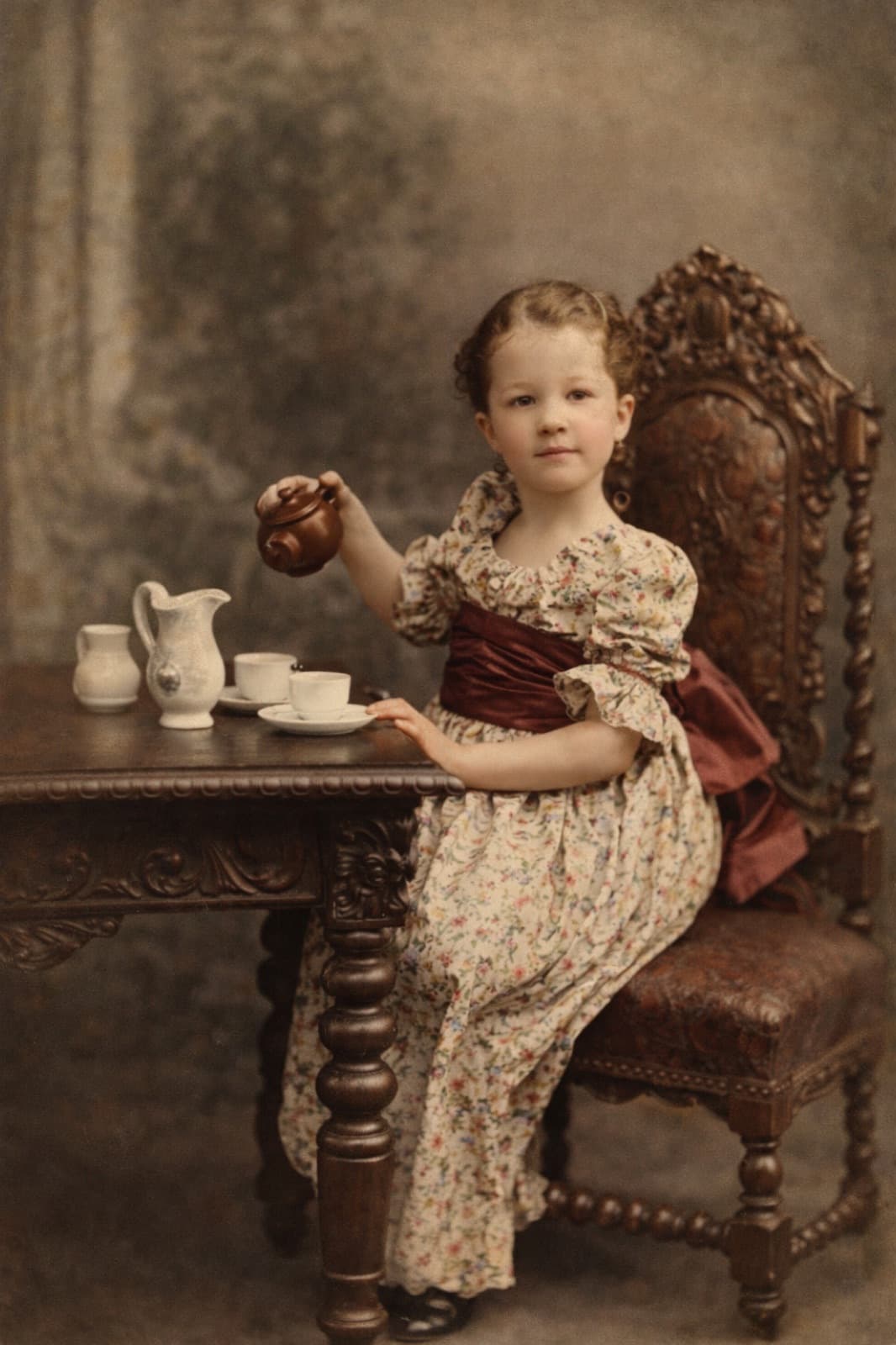
How to Date Old Photos: Visual Era Markers from 1850 to 2000
Every decade of photography has visual signatures. A practical guide to dating old family photos by hairstyles, clothing, paper type, and photographic process.

Why Dating Old Photos Matters
When you inherit a box of old family photos, the most frustrating question is often "when was this taken?" The date unlocks everything — which generation of the family is shown, what was happening historically, which relatives could have been present.
Photos often aren't dated because the person taking them didn't think they needed to be. But every era of photography left fingerprints — technical, stylistic, cultural. Reading those fingerprints lets you place an undated photo within a 5-10 year window, often within 2-3 years for well-preserved photos.
This guide covers the visual markers that matter most for dating family photos from roughly 1850 to 2000.
Step 1: Identify the Photographic Process
The physical medium is your first clue. Different processes were dominant in different eras.
1840s-1860s: Daguerreotype
- Image appears on a polished silver-coated copper plate
- Highly reflective, mirror-like surface
- Often housed in a hinged leather or wooden case
- Always a single unique print (no negatives)
- Image reads positive or negative depending on viewing angle
If your photo has these characteristics, you're looking at something from approximately 1839-1860. Rare in family collections today.
1850s-1870s: Ambrotype and Tintype
- Ambrotypes: image on glass backed with dark material
- Tintypes: image on a thin sheet of iron (not actually tin) coated with lacquer
- Both often in cases similar to daguerreotypes
- Tintypes dominated 1860s-1890s as cheap everyday photography
Tintypes were common enough that many American Civil War photos are tintypes. A tintype in your family collection likely dates to 1860-1895.
1860s-1910s: Carte de Visite (CDV) and Cabinet Card
- Small albumen prints mounted on stiff cardstock
- CDVs are approximately 2.5 x 4 inches (1860s-1880s peak)
- Cabinet cards are approximately 4.25 x 6.5 inches (1870s-1910s peak)
- Studio name and location usually printed at the bottom
- Corners rounded or square depending on decade
The studio name is gold for dating — photographer directories can often pinpoint the year within a few.
1880s-1950s: Silver Gelatin Prints
- The classic "old photo" format most families have
- Glossy or matte black-and-white paper
- Sizes standardize: 3.5x5, 4x6, 5x7, 8x10 (from mid-20th century on)
- Paper stamps on the back often indicate era
This is the overwhelming majority of family photos from the pre-color era.
1930s-1970s: Early Color Film (Kodachrome, Ektachrome)
- Color prints with often-faded tones
- Kodak's Kodachrome dominated 1935-2009
- Vivid color initially, shifts toward yellow/orange over decades
1948-1990s: Polaroid Instant
- Unique white-border square format
- Emulsion layer visible beneath clear protective coating
- Colors shift dramatically with age
1970s-present: Modern Color Print
- Standard sizes (3.5x5, 4x6)
- Paper quality improves steadily
- Borders usually thin or absent
Step 2: Read Clothing and Hairstyles
After the photo type, clothing and hairstyles are your most reliable dating tools.
Men's fashion by decade
1860s-1870s: frock coats, high collars, beards often full and long. Hair short and parted.
1880s-1890s: three-piece suits, starched high collars, mustaches very common (Van Dyke beards popular in 1880s).
1900s-1910s: sack suits, shirts with detachable collars, mustaches less common.
1920s: wide-legged trousers, double-breasted jackets, hair slicked back, clean-shaven faces.
1930s-1940s: wide-shouldered suits, fedora hats common, mustache rare except pencil-thin.
1950s: slim-fit suits, skinny ties, crew cuts or slicked-back hair.
1960s: narrow lapels early decade; by late 60s, wider lapels, longer hair, sideburns.
1970s: wide lapels, loud patterns, very long hair for men, mustaches return.
1980s: shoulder pads, shorter hair, preppy or neon palettes.
1990s: oversized fits, baggy jeans, casual shirts.
Women's fashion by decade
1860s-1870s: hoop skirts early, bustles late. Hair center-parted and pulled back.
1880s: huge bustles, high necks, tightly laced corsets. Hair piled high.
1890s: gibson-girl silhouette, puff sleeves peak around 1895-96.
1900s: S-curve corsets, hobble skirts late decade, pompadour hair.
1910s: hobble and lampshade skirts, simpler hair, occasional bobbed hair appears by end.
1920s: dropped waistlines, bobbed hair, cloche hats. Flapper style 1925-30.
1930s: bias-cut dresses, longer hair curled, shoulder pads just starting.
1940s: war-era practicality, rolled hair, padded shoulders, utilitarian dresses.
1950s: full circle skirts, tight waists, heavily styled hair.
1960s: A-line dresses, beehive hair early, mod/mini-skirts mid-decade, long straight hair late.
1970s: maxi skirts, bell bottoms, feathered hair late decade.
1980s: big hair, shoulder pads, bright colors.
1990s: more minimalist, slip dresses, straighter hair.
Step 3: Check Cars, Architecture, and Background Details
If the photo is outdoor or includes a vehicle:
Cars are dating gold
Car models are documented year by year. Any identifiable vehicle in the background can be looked up online (Google image search with "year + make + model") to place the photo within a year or two. Cars from the photo's "now" appear — not cars from decades earlier.
Architecture
Building styles evolved noticeably:
- 1900s-1920s: craftsman, ornate Victorian fading
- 1930s-1940s: art deco, streamlined moderne
- 1950s-1960s: ranch houses, mid-century modern
- 1970s: split-level suburbans
- 1980s-1990s: postmodern eclectic
Street signs, storefronts, and posters
Any readable text is dating evidence. A poster in the background for a specific movie places the photo within a year. A storefront for a business that operated 1950-1962 places the photo in that range.
Step 4: Check the Photo's Back
The physical back of a print often contains:
- Photographer's studio stamp with city and sometimes year
- Kodak or film manufacturer stamps — varies by decade
- Handwritten notes from family members
- Impressed dates from photo labs (often on the reverse border)
Kodak paper stamps on the back changed regularly and can narrow the date significantly. A photo printed on Kodak paper with a 1955-1962 stamp design was developed in that window.
Step 5: Combine All Signals
No single marker is definitive. Use all of them together.
Example: a photo shows a woman in a dropped-waist dress with bobbed hair, standing beside a Ford Model A (1928-1931), in front of a craftsman bungalow, on silver gelatin paper.
Verdict: 1928-1931, almost certainly.
Another example: a photo shows a man in a wide-shouldered suit with a fedora, beside a Chevrolet Bel Air (1950-1957), in front of a ranch house.
Verdict: 1950-1957, likely mid-decade.
When Dating Goes Wrong
Heirloom clothing
Some families kept wedding dresses, military uniforms, or religious garments for decades. A woman wearing her grandmother's 1900 wedding dress in 1970 looks like a 1900 photo. Check every other signal before trusting clothing alone.
Restored or modified old photos
Some old photos were re-touched or even re-colored in later decades. A 1940s photo that someone hand-tinted in the 1960s may have color characteristics of both eras.
Very elderly subjects
An 80-year-old woman may wear clothing and hairstyles from her own young adulthood decades earlier, even when photographed in the 1970s. Check surrounding context (people, vehicles, architecture).
What to Do with the Date Estimate
Once you've placed a photo in a time window, add that date to your family archive metadata. Our guide to starting a family photo archive (coming soon) covers cataloging systems.
For the actual restoration, knowing the era helps Restory produce better results because you can pick appropriate features:
- Pre-1960 photos: expect fading, silver mirroring, emulsion damage — use Remove Scratches + Enhance
- 1960s-80s color photos: color shift is the primary issue — use Enhance alone often suffices
- Polaroids: see our Polaroid restoration guide for specific workflow
Related Reading
- What to do with old family photos
- The ultimate guide to photo restoration
- Preserving family archives
- How to digitize old photos with your iPhone
Frequently Asked Questions
What's the single most reliable way to date an old family photo?
Cross-reference multiple signals rather than trusting any single one. The most reliable individual markers are: the photographic process (daguerreotype, tintype, silver gelatin, Kodachrome), any visible vehicles (cars can be pinpointed to specific years), and Kodak or other paper manufacturer stamps on the back of the print. Clothing and hairstyles are useful for general era but less reliable because people often wore clothing from earlier years.
How can I date a family photo that's on silver gelatin paper with no stamps?
Silver gelatin was the dominant black-and-white process from the 1880s to the 1950s, so it alone doesn't narrow much. Use clothing, hairstyles, and background details to pinpoint the decade. If the photo is a studio portrait, the photographer's mark (often a blind stamp or discreet logo on the front or back) can be looked up online to find when that studio operated. Ancestry, FamilySearch, and historical photography databases maintain records of photography studios by era.
Why are old photos sometimes hard to date even with clues?
Three main reasons: people wore heirloom or dated clothing (grandmother's wedding dress in a 1960s wedding photo), professional studios used backdrops and props that implied earlier eras, and developing technology meant photos could be reprinted or remastered decades after the original capture. If multiple signals disagree, the safest approach is to estimate a date range rather than pick a single year.
Restore your photos with Restory
AI to colorize, repair, and animate old photos. 32 languages, free trial.
Try Restory